Is artificial intelligence about to revolutionise how sport discovers its future stars? From a mobile app promising to identify tomorrow’s footballers to Senegal’s attempts to use AI to find its next Olympians and the potential impacts on horse racing, we explore how virtual thinking got physical in 2024.
Words: Elizabeth Comoy-Richardson
AI x football
Archie O’Brien’s story about how he came to have a trial at Burnley FC isn’t as dramatic as you might expect. “I walked down to my local park,” says the 17-year-old from Stanstead Abbotts in Hertfordshire. “I spent about 45 minutes doing [some prescribed drills and exercises] which were fairly simple and straightforward and then went home.” The fact that O’Brien’s neighbourhood kickabout could alert the talent hunters at a football club more than 200 miles away is down to aiScout, a new app designed by tech company ai.io to level the playing field when it comes to uncovering talent.
O’Brien’s father videoed his son completing the drills on his mobile phone before uploading the footage to aiScout. The app tested various skills: a figure of eight and diamond dribble to assess agility and ball control, a double leg jump to measure coordination, rebound jumps to test speed and a ten metre sprint to evaluate athleticism. The app’s artificial intelligence compared the results against professional benchmarks and alerted Burnley to O’Brien’s potential. The club then sent scouts to watch him play for his local team before inviting him to the club for a trial.
“Without aiScout, it’s unlikely that Burnley would have come to watch me, with the club being so far away,” says O’Brien, who has also had trials at Premier League club Chelsea thanks to aiScout. Although the trials didn’t lead to contracts, O’Brien rates their impact highly. “The trials helped me recognise things in my game that I needed to improve on and have definitely made me better overall,” he says. “After the trials, I went back to the club I played for before, but they’ve also helped me gain more opportunities at other professional clubs”. O’Brien now plays for Hertford Town in the Southern League Division One Central.
For Dr Chris Howe, research and lab manager at ai.io, O’Brien’s story is an example of why aiScout is needed. “Historically, scouting has depended on being in the right place at the right time,” he explains. “We aim to widen that funnel, ensuring that players who wouldn’t normally be seen by scouts are given a chance to stand out.”
Having started in 2019 with the aiScout app, in 2022 the company created aiLabs, a mobile unit which, its founders claim, can condense weeks of testing and data analysis into a single session, providing immediate feedback and helping players and coaches to make informed decisions quickly.
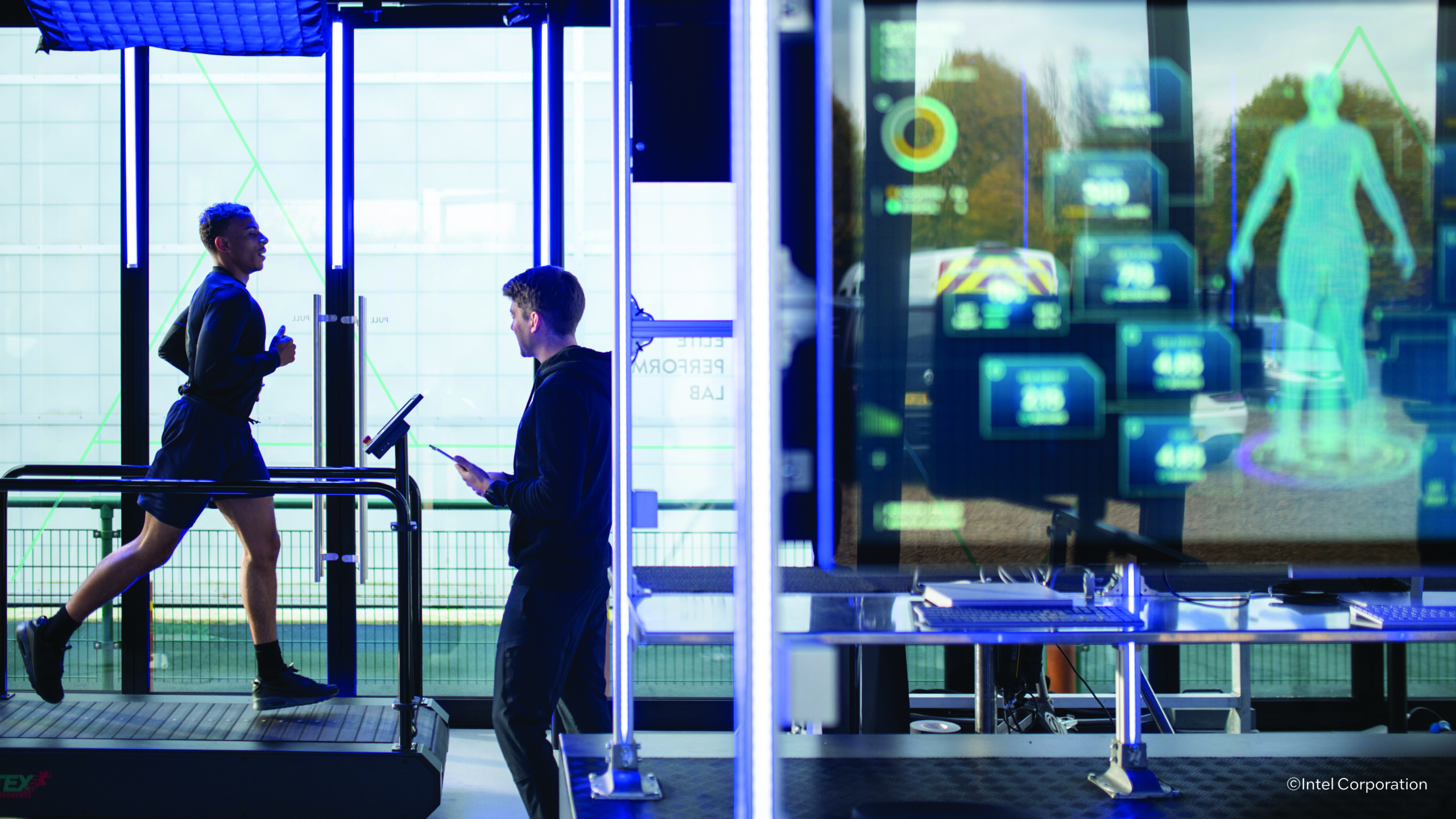
I travelled to Burnley FC’s Barnfield training grounds to see the setup in action. The sleek, glass-walled lab unit, illuminated by digital dashboards and coloured lights, and with music pumping, feels more like an Ibiza lounge than a sports assessment facility. Inside, players move quickly through a series of testing stations. Force plates measure physical development, hip abduction and adduction strength tests pick up on imbalances, while Blaze Pods put participants’ reaction times on trial with unpredictable light signals.
Real-time leaderboards flash up results, driving competition between players, whether it’s a group of U10 boys or a senior women’s first team. Behind the scenes an algorithm crunches the data, comparing results to previous scores and general averages. It highlights areas for improvement and potential injury risks, giving coaches clear, actionable insights.
O’Brien experienced the aiLabs mobile unit first hand when trialling at Burnley, and found its testing methods fascinating. “It was interesting how they analysed the data, especially the parts with the cognitive elements — the reaction and decision-making bits. Before taking part, I didn’t think there would be a test to measure those sorts of areas in football,” he says. “It would be great to have that level of testing where I play. It could push everyone to improve and give players like me even more exposure.”
But can an algorithm really replace the expert eye of a professional scout? Matt Portas, Head of Talent ID Pathways at the FA, is unsure. On one hand, he says, letting data lead the way “helps broaden the pool” of potential players by overcoming traditional biases, such as those favouring early maturing athletes. “Look at the academy system in the boy’s game in England; you’re still getting between 40 and 50 percent of the kids born in the first quarter of the school year… So, despite what the science says, football still favours the bigger and taller boys for their age.”
While AI can help overcome such bias, however, Portas is cautious about the unintended consequences of purely data-driven systems which will be unable to spot players who don’t fit the mould. “[With AI scouting] we probably are losing some of the big personalities,” Portas reflects, citing past footballing icons such as Paul Gascoigne and Roy Keane, as hugely influential players unlikely to be spotted by an algorithm.
O’Brien also worries that clubs’ pursuit of efficiency, aided by new artificial intelligence-driven technology, means there is a danger of football sacrificing the qualities that make it so enjoyable for its fans. “Instead of having exciting and entertaining players, they’re more functional and robotic, primarily focusing on winning games,” he says. “It would be good to have some more entertaining players.”
AI x the Olympics
Senegal, the host nation for the 2026 Youth Olympic Games, has become the testing ground for an innovative AI-powered talent identification programme led by Intel and the International Olympic Committee (IOC). Much like the methods used by ai.io to scout football talent, this initiative aims to uncover and nurture athletic potential in regions where traditional scouting methods might fall short.
According to Sarah Vickers, head of Intel’s Olympic and Paralympic programme, the project reflects the IOC’s growing interest in AI applications across the sporting ecosystem. “The IOC saw AI as an opportunity to enhance talent identification in a way that’s both scalable and accessible,” she explains. “Senegal was chosen not only because of its role as the upcoming host nation but also because of its potential to showcase how technology can reach athletes in previously overlooked communities.”
The programme tested more than 1,000 children across five regions in Senegal. AI-powered algorithms analysed key performance markers such as power, speed and agility, collected via video submissions. By comparing participants’ abilities to a vast dataset of professional athlete metrics, the system could identify high-potential candidates almost instantly. According to Vickers, this AI-driven method dramatically streamlines the scouting process, which often involves extensive travel, countless hours of analysis, and reliance on networks of local talent scouts. “The technology works on devices as simple as a mobile phone or PC, enabling talent identification even in remote areas,” she says.
The testing in Senegal saw that principle put into action. Brightly coloured buses travelled through the country, stopping at often remote towns and villages, where children gathered in excitement to showcase their abilities, with no need for elaborate sports kits or specialised venues. Light-sensor-equipped timing gates and smartphones captured their movements.
Vickers believes the programme has the potential to level the playing field for countries lacking the infrastructure for traditional talent scouting. “In countries like the US, junior sports programmes are well-established and heavily funded,” she says. ”But in other parts of the world, those opportunities may not exist, especially for young girls. AI offers a way to identify talent wherever it exists.”
Senegalese Olympian Amy Sène, a two-time hammer throw competitor who helped coordinate the programme, welcomed the initiative. “I got started in sport because of the Olympics, watching with my dad,” she says. Reflecting on the first trials over summer 2024, she says she was particularly impressed by the simplicity and accessibility of the tools used. “When I saw the telephones and tablets, I said ‘Wow!’ This is something truly making sports accessible. I’m so pleased to see how this technology will bring great opportunities to the young people of Senegal.”
While the initiative is still in its early stages, its impact is already evident. Of the 1,000 children tested, 40 were identified as having significant athletic potential. The next steps involve working with Senegal’s National Olympic Committee to explore their pathways for development, whether in athletics, gymnastics or other sports. The programme’s potential reach is enormous, but the costs are still considerable and questions remain over whether the resources would be better spent on grassroots coaching or improving access to sports facilities.
For Intel, this project isn’t just about discovering the next Olympians — it’s about demonstrating the potential of AI to transform sport on a global scale. “Ultimately, we want to see this technology used across all sports and in every corner of the world,” says Vickers. “It’s about making sport more inclusive, accessible, and impactful for everyone.”
The true test of the programme’s success will come at the 2026 Youth Olympic Games and in subsequent tournaments, where Senegal’s athletes, some identified through AI, will hopefully take centre stage. If the technology really can open up a sporting future for those previously overlooked, Sène believes the investment will be worth it. “Sports are great, they can change your life,” she says. “They changed mine.”
AI x horse racing
Horse racing has long been an industry driven by tradition, intuition and years of expertise passed down through generations. But Spencer Chapman,
co-owner of Equine Match, believes the future of the sport lies in a powerful combination of AI and data analytics.
Chapman, whose family has been involved in horse breeding for generations, has seen the industry evolve in recent years. He recalls how horse breeding and training used to rely heavily on the instinct of experts who could spot potential in a horse that others might miss. However, Chapman believes that the wealth of data now available can allow for better predictions about a horse’s future performance.
“AI is changing the way we understand and predict a horse’s future in the sport,” he says. “By analysing not just the horse itself but its entire bloodline – including sires, dams, and progeny – we can make highly accurate predictions about its potential performance. This goes beyond what even the most experienced trainer could guess.”
Equine Match uses a data-driven approach to predict a horse’s potential by examining the racing history of its ancestors. By analysing thousands of data points, the system can supposedly forecast with up to 95 percent confidence how a horse will perform at all levels of racing. It’s a tool that helps industry professionals make decisions based on robust data rather than relying solely on the often subjective opinions of agents and trainers.
One of the key features of Equine Match’s approach is its ability to incorporate a horse’s lineage into the prediction model. Chapman explains that this isn’t just about looking at the horse’s parents, but understanding the broader family history – how past horses in the bloodline performed and how that might translate to future success.
“There’s a natural resistance to change in any industry, especially one as steeped in tradition as horse racing. But the truth is, AI is here to stay, and those who embrace it will have a competitive edge,” Chapman says. “We’re seeing that with some of the more forward-thinking companies who are already reaping the benefits.”
One of the major challenges, however, is balancing technology with the human element that still plays a crucial role in the sport. Chapman acknowledges that while AI and data analytics are powerful tools, they are not enough on their own.
“There’s no replacing the expertise of a seasoned trainer who knows their horses inside and out. But AI allows them to make more informed decisions, helping them spot patterns and opportunities that might otherwise go unnoticed,” he explains. “It’s about using technology to enhance human judgment, not to replace it.”
With companies like Equine Match leading the charge, AI may swiftly revolutionise how the racing industry approaches talent identification. It’s part of a quiet revolution that may see the most accurate identification of future champions of the sports world coming from algorithms instead of bookmakers or scouts. As Chapman puts it, “This is just the beginning. The more data we gather, the more accurate our predictions will become. And that means better horses and a brighter future for the sport.”