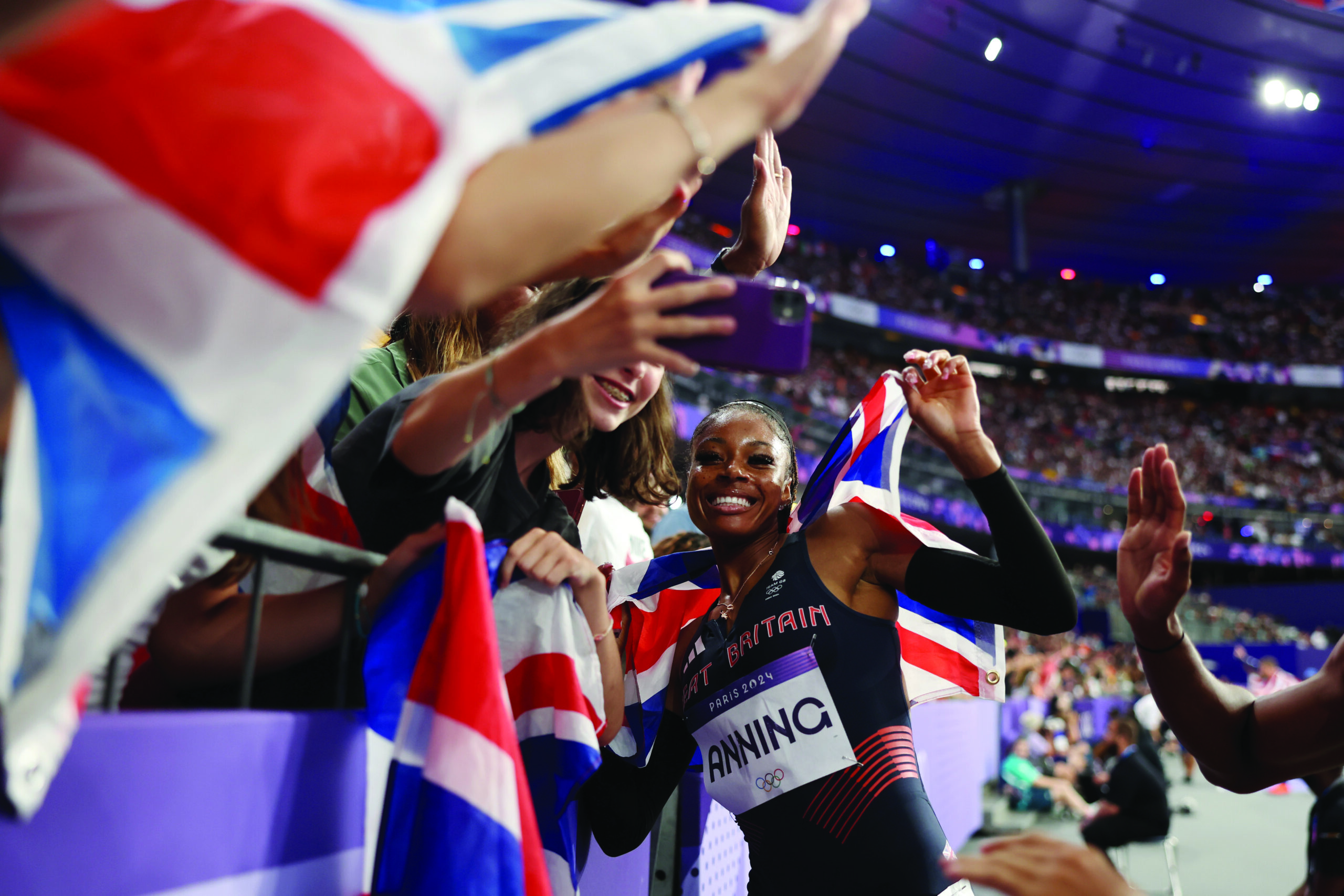
Britain’s fastest female 400 metre runner, Amber Anning, tells us about her record-breaking, Olympic medal-winning year on the track.
Words: Honor Dench
Amber Anning travelled to Paris in summer 2024 for her debut Olympics and two weeks later she flew home a double bronze medallist with success in both the women’s 400m relay and the mixed event, not to mention a British record in the individual 400m race. While the 24-year-old reached new highs in the French capital, she’s only just getting started – having recently graduated from university in Arkansas, the London-born sprinter has now turned professional, and she’s set her sights on the World Athletics Championships in Tokyo in September 2025 and beyond that the 2028 Olympics in LA.
Who are your athletics idols?
I grew up watching Usain Bolt. My mum’s family is Jamaican, so he’ll forever be an inspiration to me, just seeing his dominance in the years that he was at the top of his game. Christine Ohuruogu [who won 400m gold at the 2008 Olympics in Beijing] has been an inspiration to me too. Having the same coach, the late great Lloyd Cowan MBE, and seeing her train and having the success she had, I looked up to her a lot and knew I wanted to achieve what she achieved. I’ve been very grateful to have her as my mentor and to be coached by Lloyd. It was a blessing to have both of them in my life.
What did it mean to you to make Team GB?
Everything. All the anxiety, stress and hard work had paid off. It was an honour to cross that line at the UK Athletics Championships in Manchester in June and know I’d booked my spot in Paris. As athletes, we talk about wanting to be Olympians and medallists, but actually doing it involves a lot of hard work, dedication, time and effort. It was a very special moment, my mum awarded me my medal on the podium at the British trials for winning – that’s a memory I’ll never forget.
What is it like running the last leg of an Olympic relay final? What’s going through your head as you’re waiting for the baton to come to you?
It’s very nerve-racking – all I was thinking was ‘I’d better not mess this up’. Sometimes I think it’d be nice to be the first leg so I can get it out of the way, set them up well and watch everything unfold. Being the fourth leg carries a lot of pressure as you’re closing the show, it’s on me to continue the work of the other athletes, finish strong and get us a medal. When the baton came to me, I was thinking, ‘Amber, you just need to go!’ When I run I don’t hear anything – I’m just trying to get the stick from A to B in the fastest way possible.
In the mixed relay final, you were up against some talented athletes including a very strong USA team and Femke Bol, who ran an extraordinary final leg that helped the Netherlands win gold. What were you thinking during that race?
It was funny because the American team [who ended up winning the silver medal] was ahead of us, and Kaylyn Brown was running the last leg. I’d been in the University of Arkansas team with her all season and now we were racing each other to the finishing line, it’s a fun rivalry. I knew Femke Bol was coming, everyone knows she’s coming, but I went out to chase America down. That was my goal. In athletics anything can happen, so I never think about other people in a race. It’s about what happens on the day, you’ve just got to go out there and run your race.
What’s it like racing someone like Kaylyn Brown who was once a teammate, and is now a rival?
It’s actually really cool. We trained together the entire year, I was at the American trials when she made the team, and she watched me make the British one. At the ceremony for our medals it was great that we were both there. I was able to hug her and say, ‘Look, we did it, we both got a medal’ which was a great feeling. The beauty of our mindsets is the ability to shut down and go out and be competitive, then, when the time comes, off track we can have fun.
Did the medal in the mixed relay take the pressure off for the women’s relay final a week later?
I wouldn’t say it eased my nerves, it made me more hungry. Going into the final leg [the USA had a big lead] and it was between us, the Netherlands and Ireland for the other medals. When I got the baton, I thought, ‘This is your last race of the year, you have a holiday booked, you’re going to see friends and family, you’re going home after five years of barely being in England – just run!’ I felt my earlier races in my legs, but it was faith, heart and God that got me through.
Between the two relay finals, you also made the individual 400m final where you came fifth, breaking the British record, previously held by your mentor and idol Christine Ohuruogu in the process. How did that feel?
I was so proud of myself. I’d spoken so much about breaking the record, but I wasn’t sure if I truly felt I could do it because it had been a long year. I was in the mindset of ‘let’s make the final, and then anything can happen.’ I’d been so close to it all season, I knew if there was any time to break this record, it was at the Olympics, it was the perfect opportunity.
Was winning a medal or getting the British record more of a priority going into the Games?
You can speak about winning an Olympic medal all your life. Having a medal, whether it’s relay or individual, is something very special. Not many people can say that. To be honest at first I wasn’t happy because although I got a British record in the individual 400m I wanted that medal. It took some months for me to finally sit back and be like, ‘Wow, look at what you accomplished! This is only the beginning, and it was your first Olympics’. If anything, it has made me more determined to do better and continue to excel. To use all the experience I learned from the Games and continue to push into the future. I was just so grateful for the opportunity, and it was a dream come true – a near perfect first Olympics for me.
What did you learn at the Games that you are going to take into future competitions?
Belief. That was a big thing for me, and maybe something I lacked a little bit. Being around my teammates and in the Olympic Village, everyone’s worked hard to reach this point. We’re all very talented to even be here. It comes down to who actually has total faith that they can get the job done. I feel if I had a little bit more faith in my abilities in that [individual] final, I would’ve been even happier with the outcome. It’s a feeling I don’t want to have again.
What are the challenges facing athletes today?
Injuries are always going to be a big issue for athletes, they’re inevitable in any sport at this level. Some athletes might have a down year just because they were hurt, which can be really tough as contracts can get cut and less money is coming through. Funding is challenging to a certain extent. You’d think track is cheap, but you need facilities, equipment or travel expenses for competitions across the country; everything adds up. Luckily, there are ways people can apply for funding such as the Lloyd Cowan Bursary, which my mum Christine and others set up in honour of my coach. That’s a prime example of help to support coaches and athletes who need more money to help fuel their athletics career. It’s great because it gives opportunities to people who might not necessarily have had them without funding. I was funded a lot when I was younger, I’ve been blessed to have organisations feed into me. It was nice to be able to see them after the Games and thank them for helping me to get where I am.
What’s the most important thing you’ve learned so far in your career?
Patience. In this sport, you show up every day and sometimes you’re not going to see the fruits of your hard work, but later down the line you will see a reward. That has been the biggest thing for me; sometimes it’s hard to see that light at the end of the tunnel, but playing the long game is the most important thing.
What is it like being a woman in British athletics? Would you consider yourself a role model to girls?
It’s very powerful being a female athlete, especially in these times. Seeing Keely Hodgkinson win Sports Personality of the Year, the fourth woman in a row to do so, it really shows where women’s sport in Britain is at right now. It’s very exciting. I think anyone who’s out chasing their goals, doing what they need to do is a female role model. I’m grateful I’m in a position to inspire, because I’ve been inspired before. It’s why I do track – as much as we love the medals and the glory, being able to inspire a kid or anyone brings so much joy to my heart. That’s something I’d love to continue post track: being able to give back.
What would you say to a young female athlete who wants to race like you?
Never set limitations on yourself. Never let anyone tell you that because you’re a girl you can’t do it or you’re not fast or strong enough. I’m very big on body image and body empowerment and being happy with the body God gave you. Everyone has a gift, use it to your advantage and enjoy it.
What are your goals for 2025?
The World Championships are in Tokyo at the end of the year and I want to be an individual medallist. It would be silly for me to not have that goal in mind. That’s my main goal, but really it’s to be consistent and enjoy it.